Not Yet: Picturing a Family at the Threshold
Qin Xu, PhD student, Te Ārai Research Group
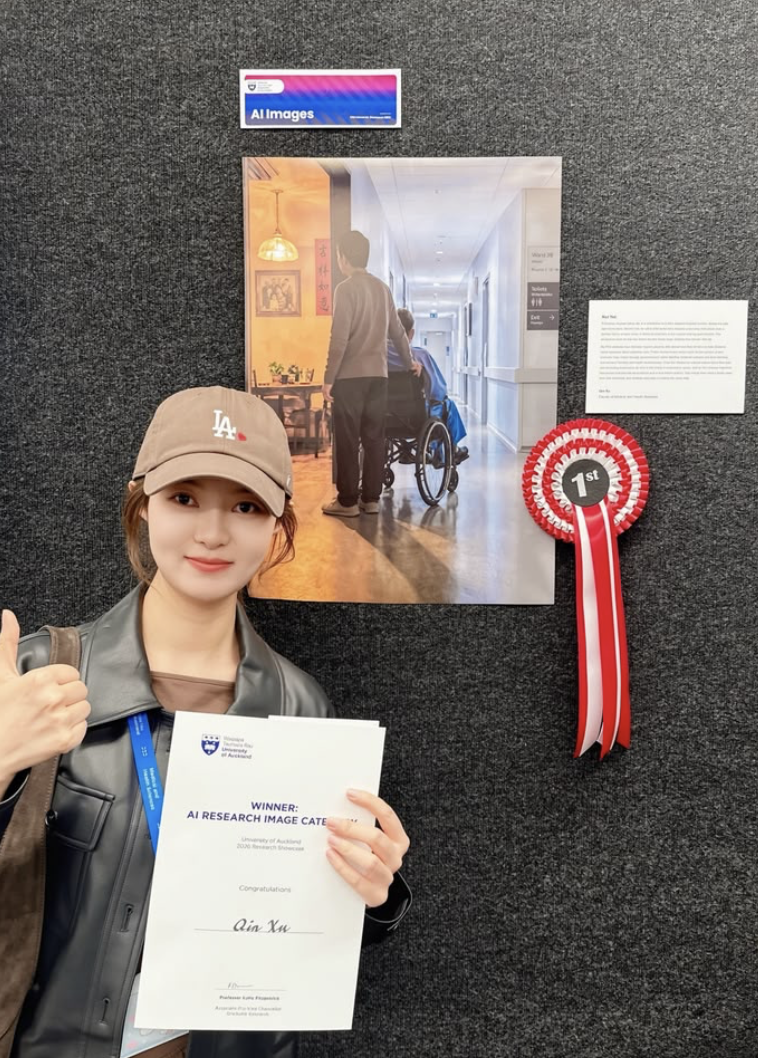
When Merryn forwarded the call for the School of Graduate Studies Research Showcase, I read the requirements carefully. The Research Image category did not need research results, only an idea, which suited someone at an early stage of research like me. So I entered, mainly to learn and gain some experience. I did not expect to win, and I was surprised and very grateful when my entry, Not Yet, received the award in the AI-Generated Image category.
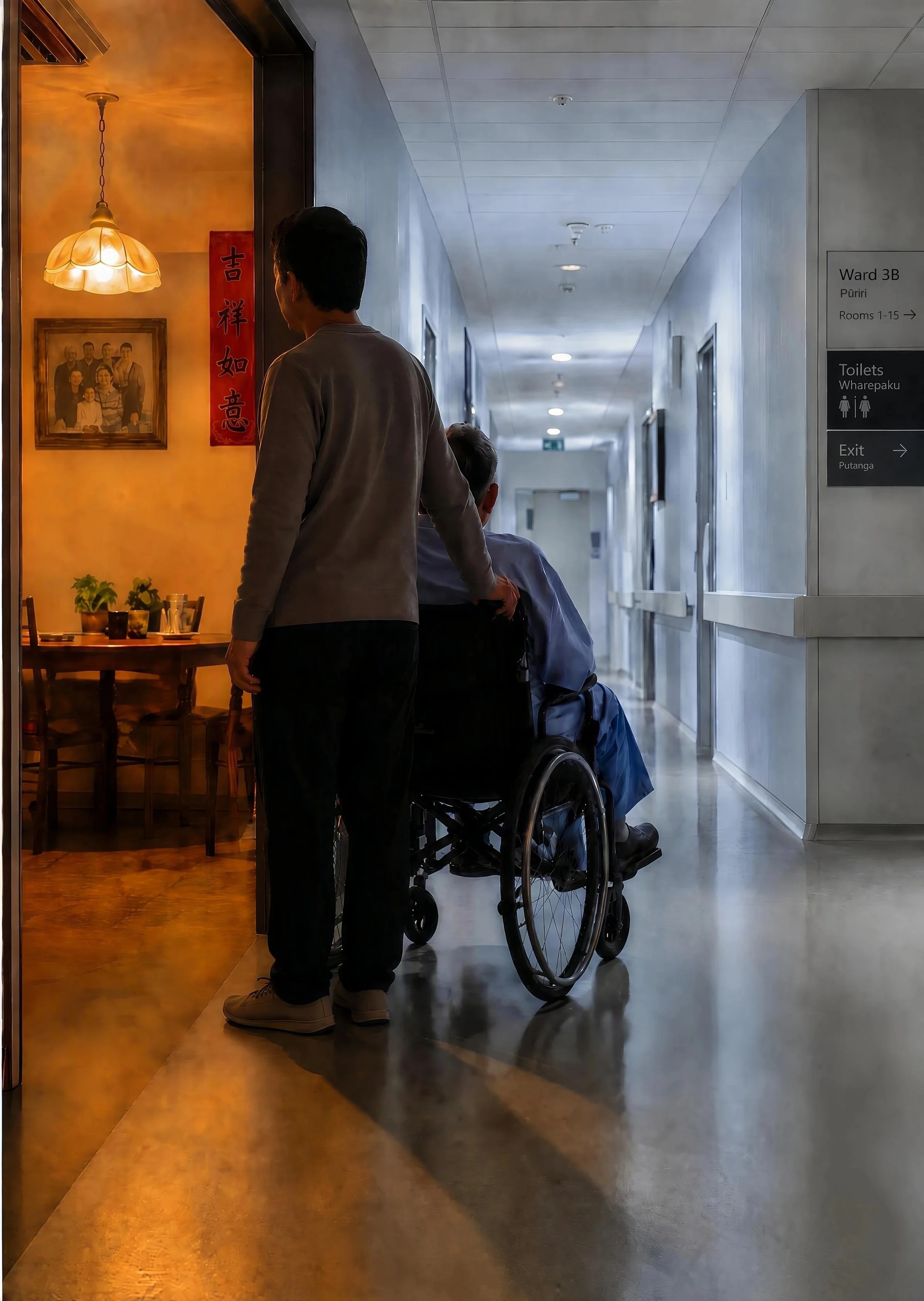
The image shows an older Chinese man in a wheelchair in a New Zealand hospital corridor. He faces the ward, under cold white light. Behind him, his adult child has turned to look back at an open doorway. Inside is a warm family room: a hanging lamp, an old family photograph, and a strip of red paper that reads 吉祥如意, a blessing for good fortune and for everything to go as you wish. On the corridor wall, the signs are in English and te reo Māori. The wheelchair has stopped on the line where the warm floor meets the cold one. Each of these details was a deliberate choice. The contrast between warm and cold light was the simplest way I could find to show two worlds at once. The red paper and the bilingual signs place the family in a specific situation: Chinese, and living here in Aotearoa. But the part I care about most is the direction of their eyes. The father and his child are not looking the same way.
That is close to the question behind my PhD. I am exploring how Chinese migrant patients with cancer and their families in New Zealand make decisions about palliative care. These decisions are rarely made by one person at one moment. They take shape through conversations: within the family, between patients and the people they love, and between families and health professionals. Culture and migration both shape these conversations, and sometimes people in the same family want different things without saying so.
I made the image with an AI tool, Meitu Design Studio, through WPS AI. I chose AI partly because I am not a photographer, but also because I did not want to photograph real patients at the end of life. It was not as quick as people might think. It took several rounds of prompts. At one point the tool turned the adult child's head the wrong way, which changed the whole meaning of the picture. It also misspelled Pūriri on the ward sign three times, so in the end I corrected that word by hand. The AI could produce the picture, but deciding what the picture should say was still my job.
At the exhibition, one question that stayed with me was a simple one: why "Not Yet"? My answer was that nothing in the picture has been decided. The family has not moved forward, and they have not gone back. Maybe, for many families, the hardest conversation has not happened yet either. Saying this aloud to strangers, again and again, helped me see my own project more clearly.
I am grateful to my supervisors, Jacqualine Robinson, Merryn Gott and Deborah Raphael, for their guidance and encouragement, and to Merryn for passing on the call in the first place. My research is also at a "not yet" stage. The questions are still unfolding, and I am looking forward to seeing where they lead.