
Palliative Care Cannot Stand Alone: Why Culture and Community Matter
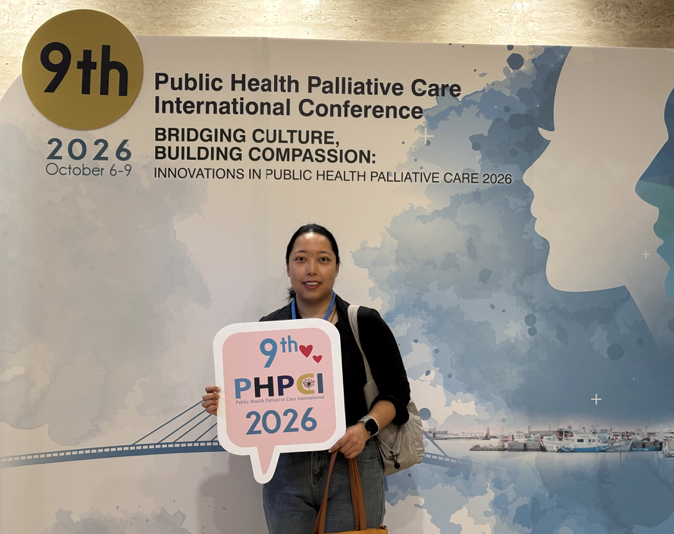
Te Ārai final year PhD student Xuan Wang reflects on the recent Public Health Palliative Care International Conference which was held in Taiwan from the 6-9 October
After attending this conference, I have been thinking a lot about one question: Can palliative care be separated from the culture and community where people live?
For me, the answer is no.
This conference brought together people from many Asian countries and different cultural backgrounds. One topic that came up many times was the role of family in palliative care. This was especially interesting to me because my own research looks at Chinese patients in New Zealand, with a significant focus on family.
In many Asian communities, family is already an important part of how people understand care and death. End-of-life care is often discussed not only as an individual issue, but also as something connected to the family.
One example from the conference stayed with me. An older man was very unwell, but he had one wish. He wanted to return to a familiar place in his community and play the erhu (a traditional two-stringed bowed musical instrument from China) with his old friends. The care team helped to stabilize his condition so that he could make this trip. He went back, played the erhu, met his friends, and then returned home. He died less than two week later.
For me, this was a very meaningful example of family and home-based palliative care. The goal was not only to keep him medically stable. It was also to help him spend his remaining time where he wanted to be, with the people and things that mattered to him. In this case, palliative care was brought closer to the family and the community, rather than being centered only on the hospital.
I also learned more about the role of family in Advance Care Planning (ACP). In some Asian settings, ACP involves many family discussions. Doctors may talk with the family and patients together. Family members may be actively involved in understanding and agreeing on the care plan. This can be important for more than one reason. It may help prevent misunderstandings and family conflict. More importantly, it reflects the role of collective decision-making in some Asian communities.
One conversation at the conference stayed with me. An older man told me that his mother had learned about ACP early in her life. This experience helped him understand death and prepare for it. Now, when he thinks about making his own ACP, he wants to bring his children, grandchildren, brothers and sisters into the conversation. He knows that talking about death can be difficult for younger family members. But he also sees it as a form of death education.
Clinical palliative care practice should not be viewed in isolation from its cultural context. An example was food. In the final stage of life, some patients may no longer be able to swallow safely. From a clinical perspective, giving them food or drinks may create a risk of choking or aspiration. But some patients still want to taste something that is important to them, and may hold cultural meaning. At the conference, I learned about an innovative approach that turns drinks into a foam. This allows patients to experience the taste while reducing some of the risks related to swallowing. I found this example very meaningful. It showed me that respecting culture does not always mean choosing between cultural needs and clinical safety. Sometimes, we can use new ideas and technology to support both.
This is probably my biggest learning from the conference.
Palliative care cannot be something that exists in isolation. It needs to grow from the communities where people live, care for each other, and experience death. Different communities may have different expectations, values, family structures, and ways of making decisions.
Even within the same health system, we still need to ask: What does good palliative care mean for this community? What does this family need? What matters to this person at the end of life?
Culturally appropriate palliative care does not have to seen as in opposition to modern medicine. Instead, culture can help us understand what people need, while medicine and innovation can help us find safe and practical ways to meet those needs.
For me, good palliative care is not only about adding more services. It is also about understanding the people, families, and communities behind those services.
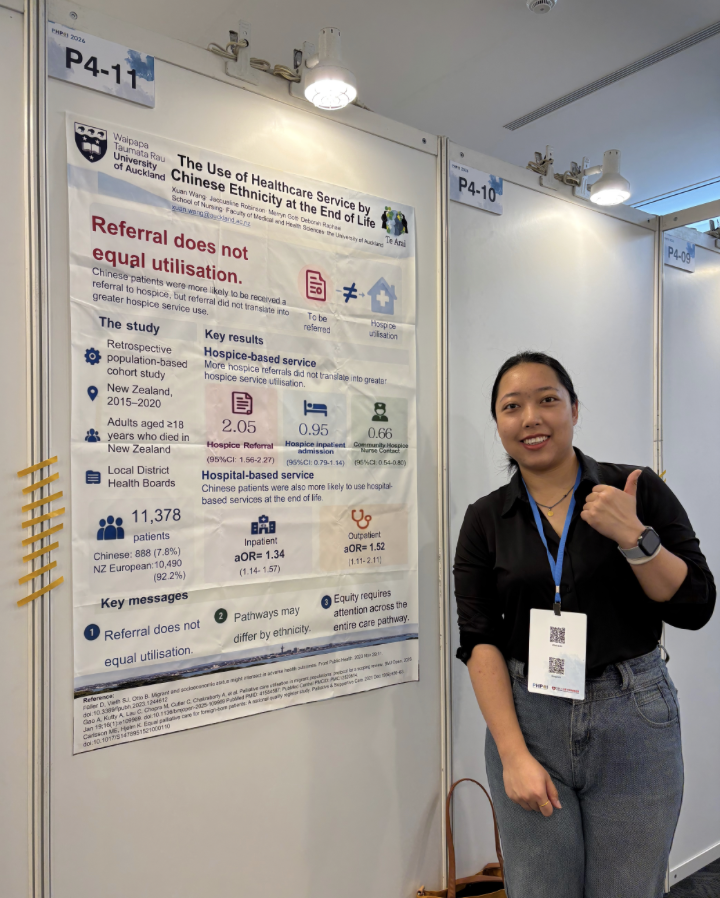
Xuan presented her poster which explored the use of healthcare services by people of Chinese ethnicity in the last year of life