
Te Whare Kaiao: Re‑imagining Paediatric Palliative Care

The Te Ārai Paediatric Palliative Care Research Team from left, Dr Deb Raphael, Professor Merryn Gott, Dr Gemma Aburn (lead), Dr Ross Drake, Dr Tess Moeke-Maxwell
As a research team working in paediatric palliative care, we are often asked some version of the same question: isn’t palliative care about dying?
Our answer is always the same—no. It is about living.
This misconception was one of the catalysts for developing Te Whare Kaiao, an Indigenous‑informed paediatric palliative care framework for Aotearoa New Zealand, recently published in the New Zealand Medical Journal. The framework emerged from kōrero with clinicians, kaumātua, whānau, and lived‑experience experts, who consistently reminded us that children receiving palliative care are not defined by prognosis. They are defined by relationships, potential, and the fullness of their lives—however long or short those lives may be. [Te Whare Kaio paper | PDF]
Why a new framework was needed
Te Whare Tapa Whā, articulated by Sir Mason Durie more than 40 years ago, remains foundational to understandings of hauora in Aotearoa. It has shaped education, policy, and practice across the health sector. Yet, as we listened to health professionals participating in paediatric palliative care education, it became clear that this generic model did not fully capture the specific realities of caring for children with serious illness.
Clinicians told us they needed something that explicitly foregrounded living, continuity across long illness trajectories, partnership with whānau, and the relational work required to support children to reach their potential—developmentally, emotionally, spiritually, and socially. Importantly, any framework had to be grounded in mātauranga Māori and developed in genuine partnership with tangata whenua, rather than retrofitted after the fact.
Te Whare Kaiao: the living whare
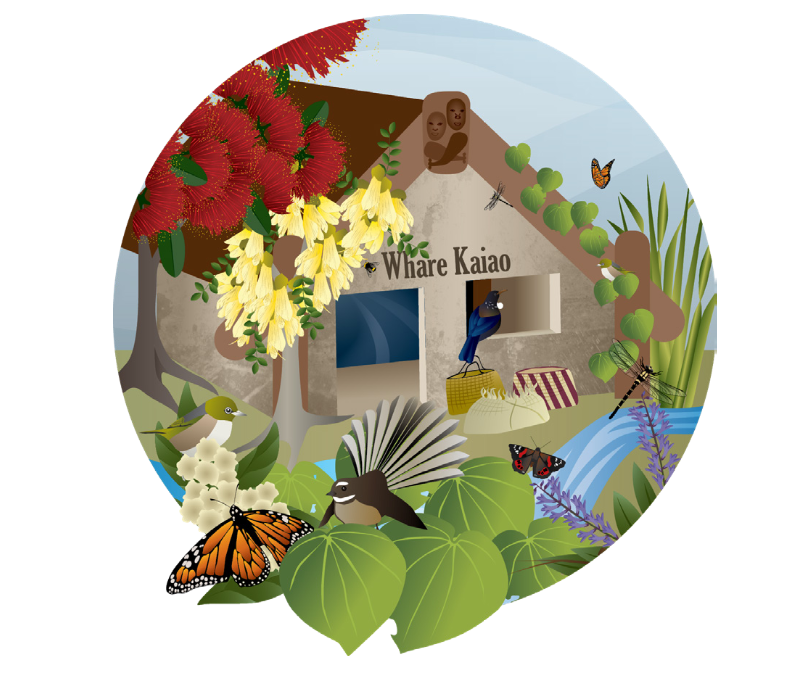
Te Whare Kaiao - the living house
Te Whare Kaiao—the living whare—builds on Te Whare Tapa Whā while making visible the interconnected, relational, and evolving nature of paediatric palliative care. The framework retains the four pou of taha tinana, taha hinengaro, taha wairua, and taha whānau, alongside whenua. What changes is the emphasis.
Paediatric palliative care, as represented in Te Whare Kaiao, is not something that begins at the end of life. It often begins at diagnosis, sometimes before birth, and may continue over many years. The framework insists that care must support childhood itself: play, connection, comfort, curiosity, and belonging. The whare is depicted as alive—surrounded by te taiao, sustained by relationships, knowledge, and collective care—because living is dynamic, not static. [Te Whare Kaio paper | PDF]
Learning from whānau and kaumātua
The heart of Te Whare Kaiao lies in the voices of whānau and kaumātua who shared their experiences of caring for tamariki with serious illness. Their kōrero challenged us to move beyond clinical task‑based approaches and attend instead to whanaungatanga, trust, and shared decision‑making.
One whānau pūrākau reminded us powerfully that families are not asking health professionals to take over, but to walk alongside them—to be on the same waka, paddling in the same direction. This requires time, humility, listening, and respect for the fact that whānau are experts in their child. It also requires systems that allow health professionals to practise in ways that are relational rather than rushed.
Symbolism as knowledge
The visual elements of Te Whare Kaiao are not decoration. They are knowledge. The pōhutukawa, the awa, the kete of knowledge, the pīwakawaka, and the ārai all communicate Indigenous understandings of life, death, transition, and connection. Together, they tell a story of care that acknowledges uncertainty, holds hope, and recognises spiritual and cultural dimensions alongside physical needs.
In developing these images with a local artist and in ongoing consultation with the Te Ārai Kāhui kaumātua, we were reminded that frameworks do not only guide practice—they signal values. Te Whare Kaiao signals that paediatric palliative care is about dignity, relationship, cultural safety, and the right of every child to be supported to live well.
What we hope Te Whare Kaiao will do
We designed Te Whare Kaiao to be used in multiple ways: to support clinical care, guide education, inform research, and empower communities. It now underpins paediatric palliative care education at the University of Auckland and is being shared across paediatric services and community settings.
More than this, we hope it prompts reflection. We hope it encourages health professionals to slow down and ask different questions: What matters to this child? Who matters to this whānau? How can we support living today, not just prepare for dying tomorrow?
Ultimately, Te Whare Kaiao is an invitation—to practise care in ways that are culturally grounded, relational, and child‑centred. It asks us, collectively, to hold life at the centre of paediatric palliative care