
Legacy Planning Begins with Relationships
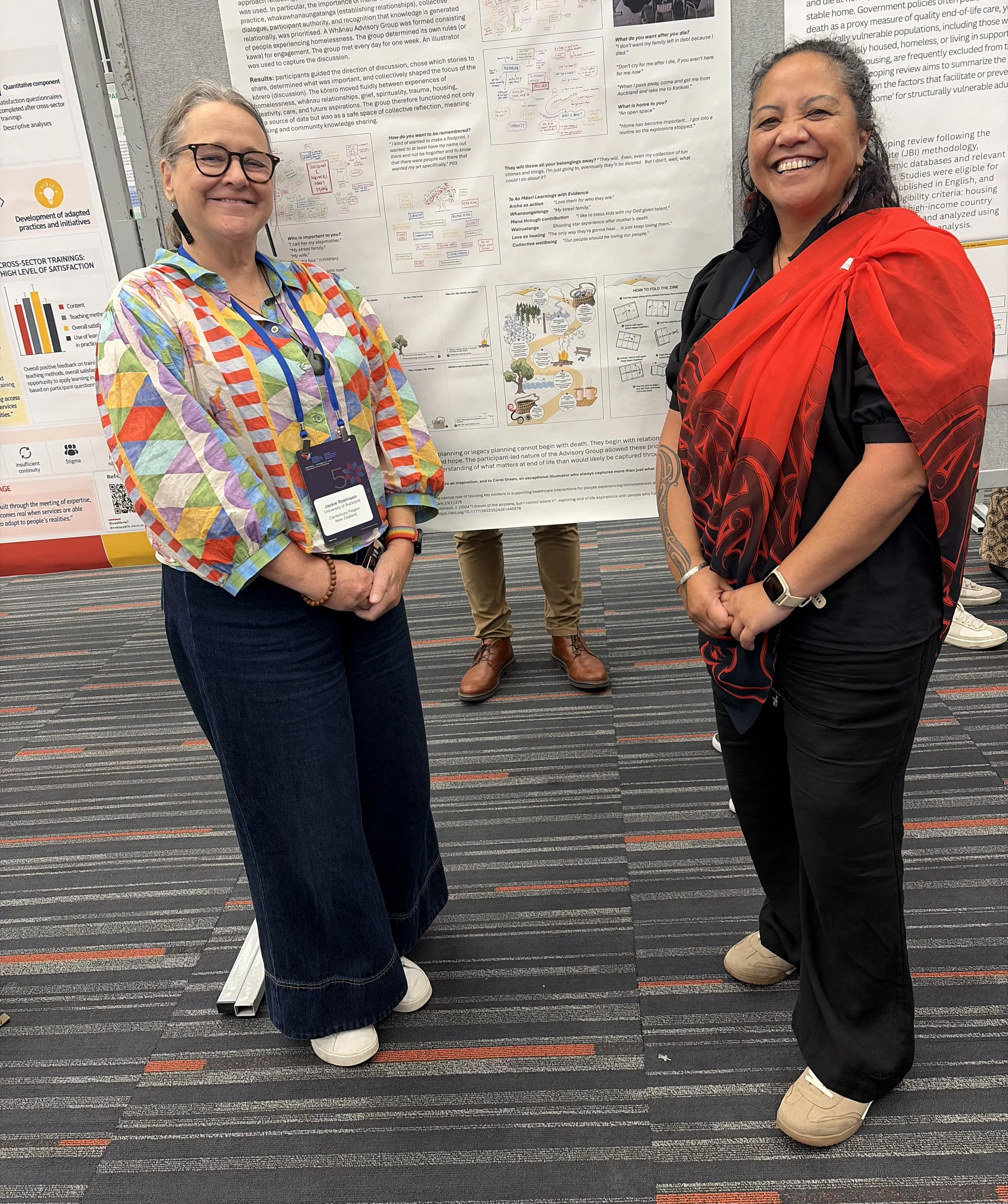
In Te Ārai is we commit to working alongside communities whose voices are often absent from palliative care research. At this year's International Palliative Care Congress, Jackie Robinson and Stella Black presented a powerful poster exploring what legacy planning might look like for people experiencing homelessness.
The project grew from a simple but important observation. Traditional approaches to advance care planning often ask people to think about future illness, death and healthcare decisions. But for many people experiencing homelessness, daily realities of poverty, trauma, addiction, stigma and housing insecurity shape what matters most. Conversations about the future cannot be separated from these lived experiences.
Rather than beginning with assumptions about what end-of-life planning should involve, the research team brought together a Whānau Advisory Group made up of people with lived experience of homelessness. The group met regularly, determined its own priorities and guided the conversations. An illustrator captured discussions as they unfolded, creating a rich visual record of the knowledge shared.
What emerged challenged many conventional ideas about advance care planning.
Participants rarely began by talking about medical treatments or future healthcare decisions. Instead, conversations centred on whānau, identity, belonging, spirituality, grief, housing, community and being remembered. People spoke about who mattered to them, the importance of relationships, and the desire for their lives and stories to be recognised.
One participant reflected on wanting to be remembered as a good person, while another described the importance of not being forgotten. Discussions about what constituted "home" revealed that home was not simply a physical place but was deeply connected to safety, routine, connection and belonging.
The project also highlighted concerns that many of us may never consider. Participants talked about treasured possessions, personal collections and belongings that represented memories and identity. Questions about what would happen to these items after death carried deep significance.
Drawing on these conversations, the team co-developed an innovative resource: "My Legacy: in a zine." Rather than a traditional advance care planning document, the zine encourages people to reflect on their story, their relationships, important places, cherished memories and how they would like to be remembered. It places identity and meaning at the centre of planning.
The findings align strongly with Māori values that underpin much of Te Ārai's work. Themes of aroha, whanaungatanga, mana, collective wellbeing and connection ran throughout participants' stories. The research reminds us that planning for the future is not simply about preparing for death. It is about recognising the things that make life meaningful.
Perhaps the most important lesson from this work is captured in the study's conclusion: meaningful conversations about advance care planning or legacy planning cannot begin with death. They begin with relationships, identity, belonging, culture, spirituality, home and hope.
For palliative care researchers and clinicians, that challenge is worth reflecting on. If we want care planning to be meaningful and accessible, particularly for people whose experiences sit outside mainstream assumptions, we may need to start by asking different questions.