
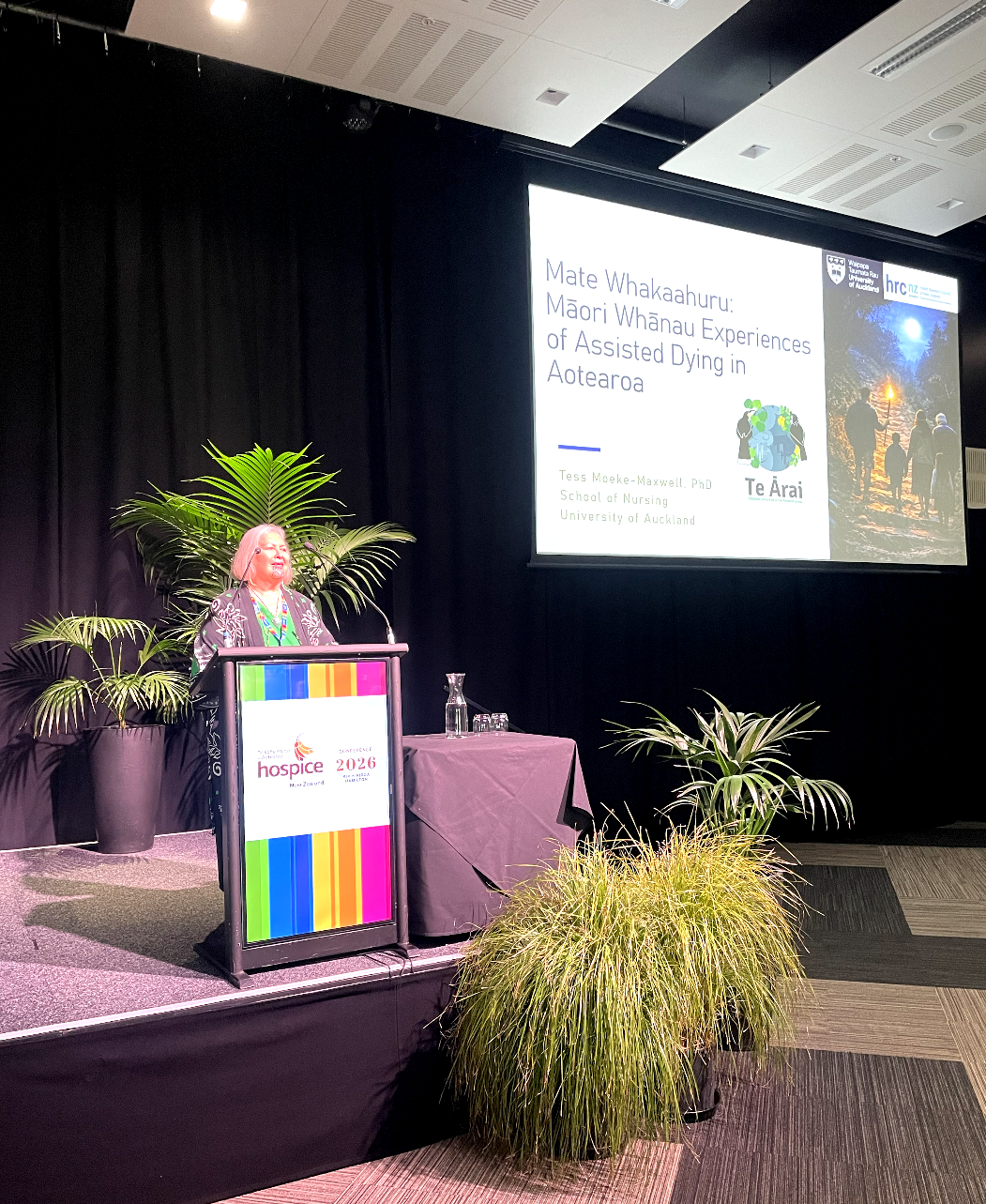
Tess presenting in Kirikiriroa Hamilton
Te Ārai Co-Director and Senior Research Fellow Dr Tess Moeke-Maxwell (Ngāi Tai ki Tāmaki, Ngāti Porou) gave the Sir Roy McKenzie Guest Lecture today at the Hospice NZ Conference on Mate Whakaahuru: Māori whānau experiences of assisted dying in Aotearoa. She shared findings from the Waerea study, a Health Research Council-funded project exploring Māori whānau experiences of assisted dying.
Assisted dying remains a relatively new and often unfamiliar experience for many whānau in Aotearoa. Led by Tess and grounded in Kaupapa Māori research approaches, the Waerea study sought to understand how Māori who are considering assisted dying, and the whānau who support them, experience this highly sensitive and deeply personal journey. In her lecture she focused specifically upon the implications of the findings for hospices in Aotearoa.
Drawing on interviews with whānau, clinicians, rongoā practitioners, spiritual leaders, tohunga and others involved in end-of-life care, Tess shared key insights from the study. These include the importance of supporting the mana motuhake of people choosing assisted dying, recognising the central role of whānau throughout the process, and understanding the emotional complexity many families experience before, during and after an assisted death. Whānau described assisted dying as a new and sometimes surreal experience, with many navigating unfamiliar processes while striving to uphold cultural values and care responsibilities.
Findings from the study have directly informed the development of Pou Kāpura, Aotearoa’s first dedicated Māori resources on assisted dying. Developed by Tess, project NIs A/Prof Jackie Robinson and Prof Linda Nikora, and advisors, the resources include graphic novels, short films, practical information and online tools designed to support informed decision-making and whānau conversations.
We congratulate Tess on sharing this important kaupapa on the national stage and helping strengthen understanding of Māori experiences of assisted dying among palliative care practitioners, researchers and service providers across Aotearoa.